World Obesity welcomes the Global Call on obesity and urges every country to join
The World Obesity Federation welcomes the Global Call for Action on Obesity: commitments 2026–2030, launched today by WHO with UNICEF, the Government of Spain and the WHO Acceleration Plan frontrunner countries.
For the first time, governments have committed together to act on three fronts at once: preventing obesity across the population, acting early for people at higher risk, and providing stigma-free care for everyone living with obesity. The Call recognises obesity as a chronic disease, commits to integrating care into primary health care, and names people living with obesity as "partners, not beneficiaries". It also commits to tackling the commercial drivers of obesity and conflicts of interest.
World Obesity urges all governments to match this ambition. The frontrunner countries are a strong start, but obesity prevention and care must be part of every country's path to universal health coverage, ahead of the 2027 UN High-Level Meeting on the issue.
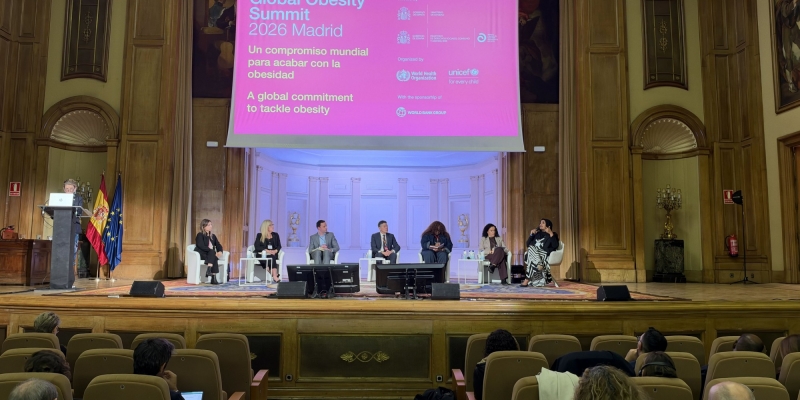
The Call follows the Madrid Global Obesity Summit, where World Obesity hosted the Global Obesity Forum for more than 140 global leaders, including people living with obesity, young people, clinicians, researchers, cities and governments. Last month, the Lancet Commission on 21st Century Global Threats to Health found obesity to be the largest avoidable health burden of this century.
Reactions from World Obesity
Dr Bruno Halpern, President, World Obesity Federation
“The Call reinforces what we now know: the only way we will successfully address obesity is an integrated prevention and management approach that places people at the centre. We applaud the Call and ask that it include even stronger commitments to care for children and adolescents. The recent Lancet Commission on Global Threats to Health called out obesity as the single biggest challenge, and the one most amenable to change if we act now”

Johanna Ralston, CEO, World Obesity Federation
"This Call is a milestone.
It treats obesity as the chronic disease it is and puts prevention and care side by side, not in competition. But the frontrunner countries cannot carry this alone. Every country is called on to step up, starting with universal health coverage to finally shift the 21st century’s most pressing global health challenge."


Voices from across the obesity community
Karen Sealey, World Obesity Federation trustee, Trinidad and Tobago NCD Alliance Founder
"The Call says people living with obesity are partners, not beneficiaries. That is the commitment we will be watching most closely. Governments must report back to the people these commitments are made for."

Stephen Ogweno, Founder and CEO, Stowelink Foundation, Kenya
"Madrid showed that obesity can be turned around when countries stop choosing between prevention and care and commit to both. As someone who grew up with obesity in Kenya, where treatment is still not covered, I welcome this Call's promise that where people live and what they earn must never decide whether they get care.
People living with obesity stand ready to help deliver it as partners, not beneficiaries."
Santi F. Gómez, Executive Director, Gasol Foundation, Spain
"The Global Obesity Summit in Madrid made it clear that it is time to accelerate an increasingly decisive and global action to promote a healthy lifestyle from early childhood. It is essential to accelerate the activation of public policies and programs that succeed in reducing the enormous health inequalities currently experienced by societies. Multi-sectoral, coordinated teamwork among public and academic institutions, civil society organizations, citizens, and businesses is our greatest hope."
Professor (Dr.) Bai Li, Director of MSc Global Health Policy Programme at the University of Bristol, and founder and chair of the LEVERAGE systems science guidelines global taskforce, UK
“The Global Call for Action on Obesity represents a significant milestone in the global fight against obesity. The Global Call for Action rings the bell that obesity has overtaken underweight as the most common form of malnutrition among children and adolescents, our world's future, while sending a powerful, energising and positive message: we can change this. As an advocate and guideline developer for systems science in public health, I am delighted to see prevention, treatment and care of obesity framed as essential, complementary parts of one strategy rather than isolated silos. This will drive directional change in future research funding and the research agenda, as well as in public health and clinical practice globally. Recognising the necessity for whole-of-government, whole-of-society action, and for integrating multimodal chronic care for obesity and its comorbidities into primary care, is a collective commitment to addressing the systemic drivers of obesity and other related NCDs through systems thinking and systems action. Now, with evidence on what works and a shared commitment to go further and faster, let us bend the global obesity curve by 2030!”
Dr Nomathemba Chandiwana, Chief Scientific Officer, Desmond Tutu Health Foundation, South Africa
“We know far more about preventing and treating obesity than we are putting into practice. The Global Call for Action is a test of whether governments can translate that knowledge into equitable, sustained action. Real commitment means moving beyond declarations to financing the health systems and services needed to deliver effective obesity prevention and care”