ICO 2026 closes in Mexico City with awards celebrating global leadership in obesity science and advocacy
The International Congress on Obesity (ICO) 2026 drew to a close on 17 July at the World Trade Center Mexico City, bringing together 2,622 delegates from 72 countries for three days of scientific exchange across the Clinical, Basic Science and Public Health tracks.
The congress – the first ICO ever held in Mexico City, in its 52nd year – closed with a ceremony recognising the researchers, clinicians and advocates whose work is shaping the field of obesity worldwide.
Hosted by the World Obesity Federation in partnership with the Sociedad Mexicana de Obesidad (SMO), the closing ceremony marked the end of Dr Simón Barquera's presidency and the start of Dr Bruno Halpern's term as incoming President, alongside the presentation of World Obesity's flagship awards and the announcement of ICO 2028, which will be held in China.
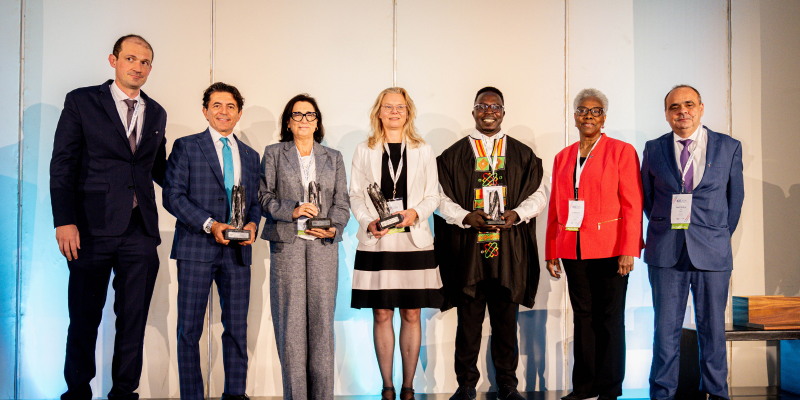
Philip James Award: Dr Simón Barquera
The Philip James Award – introduced in 2020 to recognise exceptional achievement in obesity surveillance, prevention and management – was presented to Dr Simón Barquera, outgoing President of the World Obesity Federation and Director of the Centre for Nutrition and Health Research at Mexico's National Institute of Public Health (INSP).
The award honours the distinguished career and longstanding service of the late Professor Philip James, founder of the International Obesity Task Force and former President of the International Association for the Study of Obesity (now the World Obesity Federation), to the field and to World Obesity itself.


In his address, Dr Barquera reflected on a career charting Mexico's changing food and health landscape – from early research into rising diabetes mortality and shifting food expenditure patterns in the 1980s and 1990s, through the introduction of Mexico's sugar-sweetened beverage tax in 2014 and front-of-package warning labelling in 2020, to the country's most recent school food regulations banning the sale of ultra-processed foods and sugary drinks.
He highlighted the value of sustained collaboration – with WHO, UNICEF and academic partners across Latin America and beyond – in building the evidence base that underpins Mexico's food policy reforms, and paid tribute to the mentors, colleagues and family whose support shaped his career.

Willendorf Award: Professor Antje Körner
The Willendorf Award went to Professor Antje Körner of the University Hospital for Children & Adolescents, University of Leipzig, and the Helmholtz Institute for Obesity, Metabolic and Cardiovascular Research, for her work on the biological origins of childhood obesity.
In her lecture, 'From Challenges to Opportunities in Childhood Obesity,' Professor Körner set out why erly childhood is the critical window for the condition to take hold, drawing on longitudinal data from more than 51,000 children showing that obesity established in early life persists into adulthood in over 90% of cases. Her research has traced how adipose tissue dysfunction (hypertrophy, inflammation and altered adipokine secretion) links directly to insulin resistance in children living with obesity, and how combinations of maternal and paternal weight, lifestyle factors and genetic predisposition interact to shape a child's risk.
Among her team's most striking findings is the discovery of a new monogenic obesity trait linked to ectopic expression of the agouti signalling protein (ASIP) gene, identified through screening of more than 5,000 children and subsequently confirmed in wider population cohorts. Professor Körner argued that understanding this heterogeneity is the key to precision prevention: identifying children at highest risk early enough to intervene, rather than treating obesity as a single, uniform condition. She closed by thanking her research team, collaborators across Leipzig and international partners spanning Ulm, Munich, Rotterdam, Cambridge and beyond.


Wertheimer Award: Professor María del Mar Malagón
Professor María del Mar Malagón, of the Maimónides Biomedical Research Institute of Córdoba (IMIBIC), the University of Córdoba and the Reina Sofía University Hospital, received the Wertheimer Award for her research mapping the complexity of adipose tissue across different fat depots and its crosstalk with other organs.


Her lecture, 'Mapping Adipose Tissue in Obesity: Insights into Fat Depots and Organ Crosstalk,' took delegates from patient to tissue to cell to molecule, illustrating how subcutaneous and visceral adipose tissue differ not just in location but in biology and metabolic impact. Highlights included work on the periprostatic adipose tissue secretome and its stage-dependent role in prostate cancer, and a proteomics-led effort – the Human AdipoMatrisome Project – to understand how weight gain and prediabetes remodel the extracellular matrix of fat tissue, including the discovery that lumican-rich matrices impair both adipogenesis and insulin signalling in laboratory models.
Professor Malagón also presented ongoing work using adipose tissue and serum proteomics to predict which patients are most likely to respond well to bariatric surgery – part of a broader ambition to develop a clinically usable biomarker panel that could help personalise post-surgical follow-up. She closed by thanking her Adipobiology team and collaborators across Spain.
Emerging Leaders in Health Award: Ogweno Stephen
The Emerging Leaders in Health Award was presented to Ogweno Stephen, founder of the Stowelink Foundation, member of the WHO GLP-1 Guideline Development Group and a World Obesity Federation Board member, for a decade of youth-led advocacy on obesity across Africa.
Ogweno shared his journey from a student in western Kenya who experienced stigma around obesity firsthand, to founding Stowelink as a grassroots student movement, to leading continental advocacy at the intersection of youth, policy and research. Under his leadership, Stowelink's work now spans ten countries: school health clubs and NCD youth champion networks reaching communities directly, an awareness campaign that has generated more than four million impressions across Africa, and policy engagement ranging from Kenya's trans-fat regulation and front-of-pack warning labels to East African harmonisation efforts and advocacy at the UN General Assembly and World Health Assembly.
His address set out the scale of the challenge – childhood obesity in Kenya has risen from under 10% in 2000 to 26% today, with 39% of Kenyan adults living with obesity and non-communicable diseases (NCDs) now responsible for a large share of deaths – alongside the barriers of limited access to treatment, stigma, under-funded NCD services and weak policy enforcement. In response, he announced
Beyond the Scale Africa, a new continental, youth-led movement aiming to destigmatise obesity, fight for equitable treatment access and build the next generation of African health leaders. "The question was never whether Africa has an obesity crisis," he told delegates. "The question is who will lead the response. We are already leading it."
He dedicated the award to the Stowelink team, describing it as belonging to "a movement, not a person."


Best Oral Abstract and e-Poster Awards
Alongside the flagship awards, each of the three ICO 2026 Track Committees recognised the strongest original research submitted to the congress.
Best Oral Abstract Awards
- Clinical: Patricia S Castillo-Flores
- Basic Science: Nanna Skeltved
- Public Health: Sameera Mahomedy
Best e-Poster Awards
- Clinical: Paula Axicalli Hernandez
- Basic Science: Rafel Silva Lima
- Public Health: Anne Barrow
Looking ahead
The closing ceremony also marked a formal changing of the guard, with Dr Bruno Halpern taking over as World Obesity President from Dr Simón Barquera. In his first address, Dr Halpern set out priorities for his term: transforming obesity education, advancing universal, evidence-based access to obesity care, moving beyond a false prevention-versus-treatment divide, championing multidisciplinary leadership that includes the voices of people living with obesity, strengthening global collaboration with a particular focus on low- and middle-income countries, and modernising how obesity science is communicated to the public.
ICO 2026 also saw the announcement that the next congress, ICO 2028, will be held in China in partnership with the China Obesity Federation, under the theme "One World, One Health."
Related News
View all
News Jul 20, 26
World Obesity Federation welcomes new President and President-Elect
World Obesity's pleased to announce the appointment of Bruno Halpern & Sir Collin Tukuitonga to our leadership.
Read Post
Events SCOPE Jul 31, 26
SCOPE School Mexico 2026: our biggest ever, and the curtain-raiser for ICO 2026
The largest we've ever delivered, SCOPE School Mexico, took place at the International Congress on Obesity in July.
Read Post
Events Blog Aug 03, 26
Connecting with our Members at ICO 2026
Connecting with so many of our Members was the highlight of ICO 2026 for our membership team.
Read Post